Brown Military Academy

Captain Thomas A. Davis was a retired army officer who had seen service in Puerto Rico during the Spanish-American War in 1898. In 1910 he moved to Pacific Beach and founded the San Diego Army and Navy Academy at what had originally been the campus of the San Diego College of Letters on the four blocks surrounded by Garnet Avenue and Jewell, Emerald and Lamont streets.
San Diego Army and Navy Academy began with 13 cadets but by 1915 the ‘battalion of cadets’ totaled more than 100, most of whom were resident on campus. By 1924 enrollment was over 200 and another construction project, a mess hall seating over 300, was completed. A new concrete gymnasium/auditorium building with a stage, motion picture projection room and an indoor range for rifle practice was built in 1927 and an infirmary building, in the Spanish architectural style, was also added that year. In 1928 enrollment stood at over 300 and Col. Davis (he had received an honorary ‘Kentucky Colonel’ commission in 1922) announced an ambitious construction program designed to give the academy a housing capacity of 1000 cadets. A three-story concrete dormitory was scheduled for completion in time for the 1929 fall term, when 400 or more cadets were expected and three more concrete dormitories of four stories were dedicated in 1930, the academy’s twentieth anniversary. The dormitories or barracks were of California-Spanish architecture, ‘distinguished by graceful arches, long esplanades and a beauty of design that is typically Californian’. This row of massive concrete dormitories or barracks completed in 1930 dominated the skyline of Pacific Beach for decades.
1930 was also the year that the economic effects of the Great Depression began to be felt and establishments of all kinds, including private boarding schools, experienced painful contractions. By 1932 enrollment at the academy had declined to about 200 and remained near that level for years, causing the academy to fall further behind in payments to its creditors. In March 1936 the bank declared the academy’s loans to be in default and gave notice of its intention to sell the property. Unable to meet the bank’s demands Col. Davis stepped down and in March 1937 the academy property in Pacific Beach was purchased by the John E. Brown College Corp. and renamed Brown Military Academy. Col Davis was allowed to retain the San Diego Army and Navy Academy name for a new school he started in Carlsbad.

A little over a year later, in December 1938, Col. Davis resigned the presidency of his academy in Carlsbad and shortly after that, in March 1939, went back to Pacific Beach to work for Dr. Brown as assistant to the president. In February 1940 he was appointed president of Brown Military Academy, assuming essentially the same position he had held, with a short interruption, since founding the academy 30 years earlier. Ironically, the academy he returned to in Pacific Beach is now long gone while the Carlsbad academy, its name shortened to Army and Navy Academy, is still in operation.
Col. Davis remained at the head of Brown Military Academy for nearly 15 more years, retiring in 1954. Although a strict disciplinarian himself, he did what he could to soften the more ascetic policies instituted by the new administration. In the matter of dancing, Col. Davis wrote to the manager of a local orchestra in 1941 that while Dr. Brown had banned dancing on campus, or even attending dances in the city, there had been ‘something of a change’ since his return and the boys ‘sometimes arranged social affairs of this kind off campus’. They might be planning ‘something of the kind’ soon and he was interested in details about her orchestra, including prices. By the 1950s these off-campus social affairs had become regular items on the society pages of the local papers. In 1954, for example, the Union announced a formal Valentine’s Day ‘Sweetheart Dance’ hosted by the senior class at La Jolla Beach and Tennis Club. The academy orchestra would provide the music and the guests would include young ladies from The Bishop’s School at La Jolla. Girls from The Bishop’s School were again guests of Brown’s Letterman’s Club for a formal dance at the Beach and Tennis Club in October.
Mornings at the academy were devoted to academics and afternoons to athletics. The academic and military preparation provided to cadets enabled the academy to nominate them for admission to the national service academies. Athletically, the academy fielded teams which competed in local interscholastic leagues. Music was a major emphasis and Brown Military Academy had a highly regarded marching band (and also a dance orchestra for those occasional off-campus social affairs). The marching band appeared in academy ceremonies and also in parades around the city. Patriotic holidays in Pacific Beach often featured the academy band in parades on Garnet Avenue, beginning near the beach and often ending with a ceremony at the academy flagpole. For parades and other formal occasions the cadets, including junior school students, wore full dress uniforms like those worn by cadets at the United States Military Academy at West Point.
The years following the Brown acquisition of the academy in 1937 were also a period of tremendous growth in Pacific Beach. Consolidated Aircraft had moved to San Diego in 1935 and opened a factory near the airport, attracting tens of thousands of aircraft workers to San Diego to build B-24 Liberator bombers. World War II led to the arrival of even more workers, as well as military personnel and employees, leading to tremendous growth in areas within commuting distance of the factories and bases, including Pacific Beach. Population growth and housing construction continued in the post-war period and by the mid-1950s most areas of Pacific Beach, including the area surrounding Brown Military Academy, had been fully built out.
Population growth also led to commercial development in Pacific Beach, particularly on Garnet Avenue, the community’s main street. Brown Military Academy occupied three blocks on Garnet and as the commercial value of this property increased it began selling off portions of it to developers. Part of the athletic field and parade ground fronting on Garnet west of Jewell became the site of a Safeway supermarket in December 1950. However, in February 1958 the San Diego Union reported that the entire academy would close that summer and relocate to the site of another Brown school in Glendora to make way for commercial development of its remaining 23-acre campus in Pacific Beach. The academy administration announced that the land was being ‘released’ to meet the community’s need for its rapidly increasing business expansion; retention of the campus for school purposes would not be wise in view of the land’s increased commercial value. The move had been under study for three years as the school was increasingly being ‘hemmed in’ by the community’s growth. The purchase price was said to be more than a million dollars.

The Pacific Beach academy’s final commencement exercises were held in June 1958 and Col. Davis was present as honorary reviewing officer. The Evening Tribune reported that Col. Davis, then 84 years old, was unable to stand to take the review but he sat at rigid attention with his cane held straight up as 400 of his ‘gray-clad boys’ marched by. His life story, which included the founding of the academy in 1910, was read over the public address system as a tribute to him. The Tribune added that immediately after the commencement exercises Brown Military Academy would move to Glendora.
Although it was expected that most of the 475 cadets and 90 faculty members would make the move to Glendora, a few who preferred to remain in the San Diego area joined former headmaster Louis Bitterlin in opening the San Diego Military Academy in the former Las Flores Inn in Solana Beach. This academy also closed in 1977 and the site, on Academy Drive in Solana Beach, is now occupied by Santa Fe Christian Schools.
Development of the southern and western portion of the college campus property was soon underway, beginning with the demolition of the historic buildings dating to the days of the San Diego College of Letters. In August 1958 the San Diego Union reported that workmen razing buildings of the former Brown Military Academy found papers dating from 1887 in a tin baking soda can in the building’s cornerstone. These were artifacts from the January 1888 ceremony for which many residents of San Diego traveled over a new railroad line to the new community of Pacific Beach to welcome its first building, originally a college, later a hotel and finally a military academy.
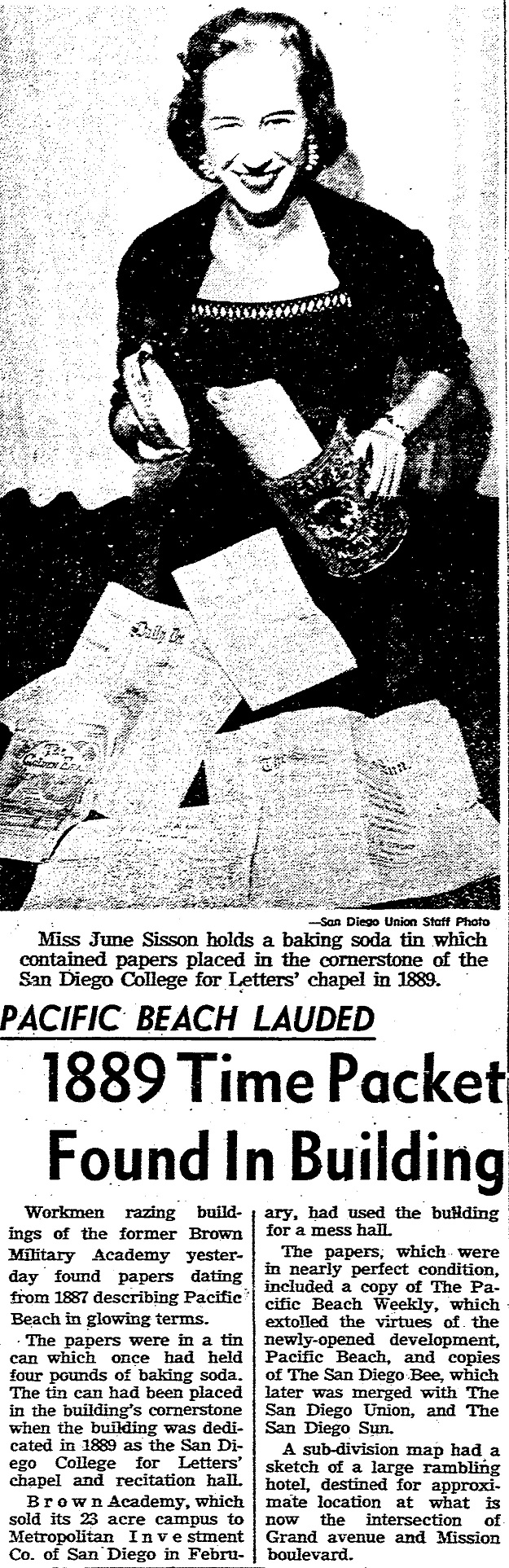

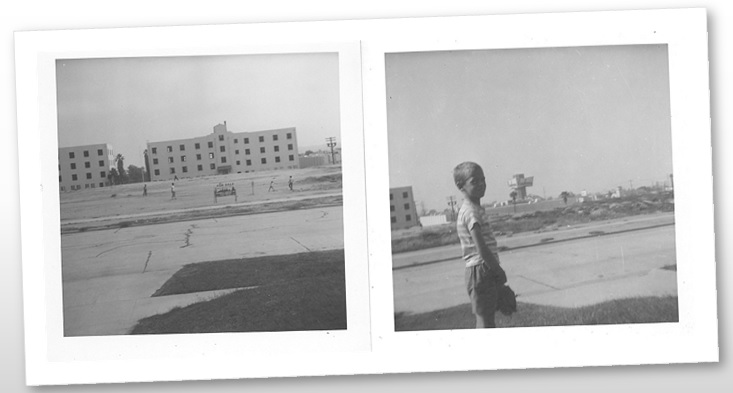
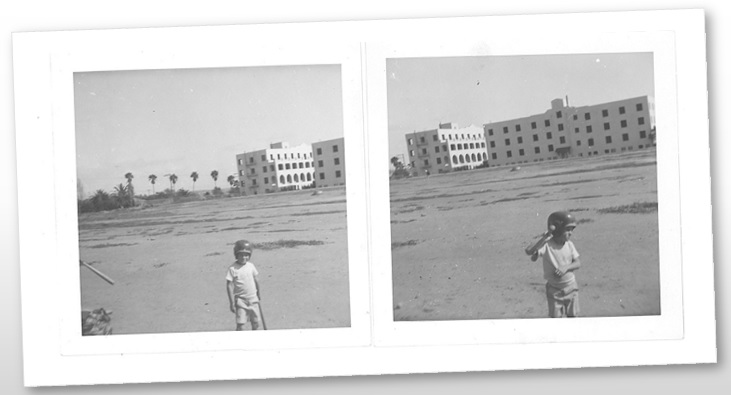
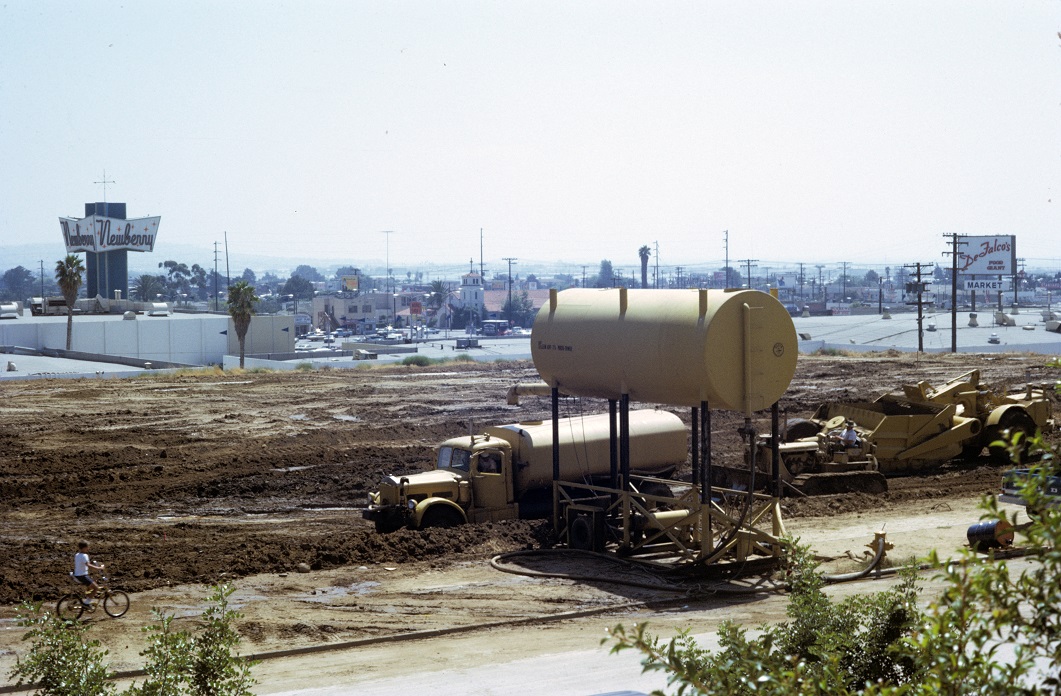
A groundbreaking ceremony for the Pacific Plaza shopping center was held on May 17, 1960, and stores were open within a year. The original plan was to retain and remodel the four reinforced concrete dormitory buildings in the north eastern portion of the College Campus as a ‘geriatrics center’. The geriatrics center never happened but the abandoned buildings did remain standing for years, during which time they were thoroughly ransacked and all their windows broken (and the former academy property between the abandoned buildings and Diamond Street became a de facto playground for neighborhood kids). Col. Davis lived across Lamont Street from the dormitory buildings and sadly had to witness the deterioration of the institution to which he had devoted nearly 50 years of his life. Col. Davis died in 1964, the last academy buildings were finally demolished in 1965, and the Plaza apartments (later condominiums) were being built on the site by 1970. Today the only sign of Brown Military Academy in Pacific Beach is a small plaque in a parking lot at the corner of what was once its campus.

Comments